


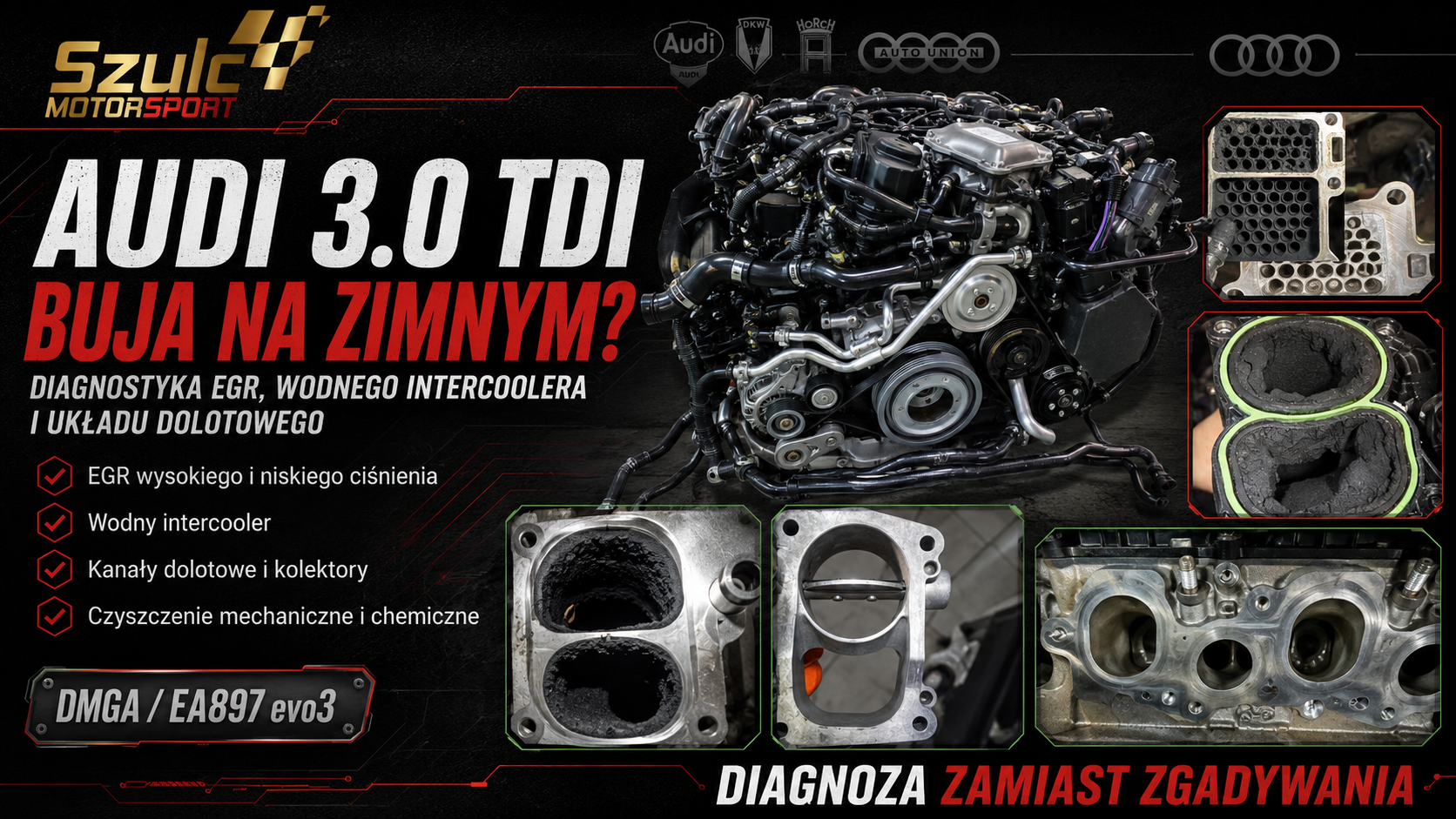
15April2026Audi 3.0 TDI Rough on Cold Start – EGR, Charge-Air Cooler and Intake Diagnostics
Audi 3.0 TDI Rough on Cold Start – EGR, Charge-Air Cooler and Intake Diagnostics
A modern Audi 3.0 TDI engine may shake noticeably after a cold start, transmit vibrations through the body or run harshly and unevenly for several seconds. The rev counter may remain almost steady, no fault codes may be stored, and the engine may regain its usual smoothness once it begins to warm up.
Two quick diagnoses are usually suggested: faulty injectors or a contaminated intake manifold.
Both are possible. Neither can be confirmed from the driver’s impression, a single injector correction reading or the vehicle’s mileage alone.
At Szulc Motorsport, we begin by reproducing the fault with the engine completely cold. We analyse cylinder balance, the fuel system, airflow, EGR control, temperatures and the mechanical condition of the engine. Only then do we decide whether dismantling, cleaning or component replacement is justified.
We do not sell random “intake manifold cleaning”. We inspect and restore the entire airflow and exhaust-gas recirculation path.
Engine rocking is not always the same as fluctuating idle speed
Drivers describe the problem in different ways:
- the car rocks after the first start of the day,
- uneven pulses can be felt through the seat and steering wheel,
- the engine runs harshly for the first few seconds,
- there is light jerking at idle,
- the engine vibrates despite almost stable revs,
- the symptoms improve noticeably as the engine warms up,
- the fault becomes more pronounced after a long standstill or in low temperatures.
Engine rocking and fluctuating idle speed are not the same thing.
Fluctuating idle means a visible change in engine speed. Rocking can occur while the revs remain nearly stable, when individual cylinders do not deliver equal torque to the crankshaft.
This does not mean that every unstable idle is caused by the fuel system, or that every vibration comes from a contaminated intake. Similar symptoms can be caused by several different systems, so a proper diagnosis requires data logging and reproduction of the conditions in which the fault actually occurs.
Why does an Audi 3.0 TDI run unevenly mainly when cold?
A cold start is one of the most demanding operating phases for a diesel engine. Cylinder temperatures are low, self-ignition conditions are less favourable, and the engine control unit must stabilise combustion while also beginning to warm the engine and the exhaust aftertreatment system.
Depending on the engine generation, temperature and operating conditions, the control unit adjusts, among other things:
- fuel quantity and injection strategy,
- Common Rail pressure,
- the proportion of recirculated exhaust gas,
- the position of intake throttles and swirl flaps,
- fresh-air mass,
- thermal-management strategy,
- coolant pumps and control valves.
At this stage, even a small difference between cylinders can become clearly noticeable. If one cylinder receives a different amount of fresh air, a different proportion of recirculated exhaust gas or has poorer compression and ignition conditions, its contribution to engine operation will differ from the others.
The engine control unit detects this imbalance partly through changes in crankshaft speed and attempts to compensate for it. The driver feels the result as vibration, body movement or brief jerking.
As the engine warms up, combustion conditions improve and EGR and airflow strategies change. The symptom may then weaken considerably, even though the physical cause is still present.
Cylinder correction values are not a diagnosis of faulty injectors
One of the most common mistakes in Audi 3.0 TDI diagnostics is condemning an injector solely because one cylinder shows a different correction value.
A cylinder correction value shows how the engine control unit is attempting to balance that cylinder’s contribution. It does not explain why the cylinder is behaving differently.
Possible causes include:
- incorrect injector operation,
- unequal air delivery,
- an intake port restricted by carbon deposits,
- deposits on an intake valve,
- incorrect EGR operation,
- a sticking flap or throttle valve,
- an intake-system leak,
- a compression difference,
- a leaking valve or valve seat,
- incorrect fuel pressure,
- an electrical or mechanical fault.
The injector may be the cause, but it may also be a fully functional component working in a cylinder whose imbalance originates elsewhere.
This is why we do not replace injectors on the basis of one correction-value screen.
Audi 3.0 TDI – one engine size, many different designs
The 3.0 TDI designation covers several engine generations, power outputs, engine codes and exhaust aftertreatment systems.
These V6 TDI engines have been fitted to models including:
- Audi A4 and A5,
- Audi A6 and A7,
- Audi A8,
- Audi Q5,
- Audi Q7,
- Audi Q8.
Older engines used in the Audi A6 C6, A8 D3 and Q7 4L differ from the units fitted to the A6 C7 and A7 C7. Later versions used in the Audi A6 C8, A7 C8, Q7 4M, Q8 and newer A4, A5 and Q5 models are different again.
Engine codes found across the different generations include:
- BMK, ASB, CDYA – earlier V6 TDI designs,
- CLAA, CDUC, CRTE, CRTD – later EA897 variants,
- DCPC, DDVB, DDVC, DDVE, DDVF, DHXA, DHXC – second-generation EA897 units,
- DMGA and DMKD – EA897 evo3 engines with indirect liquid-cooled charge-air cooling.
This is not a complete list. The same vehicle model may use different EGR, cooling and intake-system layouts. Before any work begins, we identify the exact construction from the VIN, engine code, production date and the components actually fitted to the vehicle.
How the problem evolved – from contaminated manifolds to a complex airflow system
In earlier Audi 3.0 TDI generations, deposits accumulated mainly in the intake manifolds, on the swirl flaps, inside the EGR system, in the cylinder-head intake ports and on the rear surfaces of the intake valves.
Soot introduced by the EGR system mixed with oil mist from the crankcase ventilation system. This formed a sticky layer that trapped further contamination. Over time, the deposit hardened and increasingly reduced the effective cross-section of the intake passages.
This could cause:
- restricted swirl-flap movement,
- differences between the two cylinder banks,
- uneven airflow distribution between cylinders,
- poorer throttle response,
- reduced refinement, particularly when cold.
In later engines, the carbon-deposit problem did not disappear. Instead, additional components were introduced to control airflow, temperature and emissions.
Depending on the generation, the system may include:
- a high-pressure EGR circuit,
- a low-pressure EGR circuit,
- coolers for both EGR paths,
- EGR-cooler bypass valves,
- additional throttles and regulating flaps,
- separate coolant circuits,
- a liquid-cooled charge-air cooler.
This is why a modern Audi 3.0 TDI problem cannot be reduced to one dirty intake manifold.
High-pressure EGR
The high-pressure EGR circuit takes exhaust gas from the high-pressure side of the exhaust system and routes it back to the intake through a relatively short path.
Depending on the version, the system may include:
- a high-pressure EGR valve,
- an EGR cooler,
- a cooler bypass,
- control flaps and valves,
- exhaust-gas transfer pipes.
Contamination can cause:
- slower valve response,
- intermittent sticking,
- restricted valve travel,
- failure to close accurately,
- uncontrolled exhaust-gas flow,
- a difference between expected and actual flow.
The absence of a stored fault code does not prove that the entire EGR path is operating correctly.
Low-pressure EGR
The low-pressure EGR circuit uses a much longer flow path. Exhaust gas is taken from further downstream in the exhaust system, after the exhaust aftertreatment module, and routed back to the inlet of the turbocharger compressor.
The mixture of fresh air and recirculated exhaust gas then passes through:
- the turbocharger compressor,
- the charge-air cooling system,
- the throttle valves and airflow-control components,
- the intake manifolds,
- the cylinder-head intake ports,
- the intake valves,
- the cylinders.
Contamination from the low-pressure EGR circuit does not necessarily remain inside one EGR valve. Deposits may gradually build up in subsequent components throughout the complete airflow path.
This is why proper diagnostics must include not only the EGR valve, but also the cooler, connecting pipes, turbocharger, charge-air cooling system and the rest of the intake tract.
EGR coolers – deposits, restriction and leakage
On a modern 3.0 TDI, it is necessary to inspect not only the EGR valves, but also the coolers and their bypass systems.
An EGR cooler may appear normal externally while its internal passages are partially restricted by deposits. This changes both the quantity and temperature of the exhaust gas being returned to the engine.
During inspection, we assess:
- flow through the exhaust-gas side,
- coolant-side integrity,
- operation of bypass valves,
- the condition of connections and fittings,
- signs of corrosion,
- traces of coolant or unusual deposits,
- whether full flow can be restored safely.
Not every cooler should simply be cleaned and refitted. If the core is leaking, damaged or its flow cannot be confirmed, replacement is the correct solution.
Coolant loss, steam or white smoke after start-up requires separate diagnosis. We do not automatically blame the EGR cooler, because similar symptoms can have other causes.
Liquid-cooled charge-air cooler in the latest Audi 3.0 TDI engines
EA897 evo3 engines, including DMGA and DMKD variants, use indirect liquid cooling of the charge air.
The system uses a charge-air cooler located directly in the compressed-air path, a separate coolant circuit, an electric circulation pump and temperature-control components.
In engines using low-pressure EGR, the airflow passing through this section also contains recirculated exhaust gas. The cooler surfaces may therefore collect:
- soot,
- oil mist,
- moisture,
- oil-degradation products,
- sticky deposits formed by a combination of these contaminants.
Deposits may reduce the effective airflow area, the heat-transfer surface and the cooling efficiency of the charge air.
We do not assume that every rough-running modern 3.0 TDI has a blocked charge-air cooler. Its condition must be confirmed through diagnosis and often through physical inspection after dismantling.
Why does the turbocharger sometimes have to be removed?
On selected modern Audi 3.0 TDI versions, access to the liquid-cooled charge-air cooler and the components located between the cylinder heads requires extensive dismantling.
Depending on the engine code and installation, the work may include removal of:
- air and coolant pipes,
- components of both EGR circuits,
- intake manifolds and swirl flaps,
- wiring, brackets and heat shields,
- the turbocharger.
This is not a quick service involving the removal of one plastic cover and spraying a cleaner into a running engine.
Once access has been gained, we inspect the charge-air cooler for:
- the extent of contamination,
- core restriction,
- coolant-circuit leakage,
- corrosion and deformation,
- mechanical damage,
- whether it can be cleaned safely.
We do not clean the charge-air cooler at any cost. If its integrity, flow or safe continued use cannot be confirmed, replacement is the correct solution.
Why cleaning only the intake manifold is not enough
Deposits in a 3.0 TDI may be present simultaneously in several locations:
- the EGR valves,
- the EGR coolers,
- the exhaust-gas recirculation pipes,
- the throttle valves and swirl flaps,
- the charge-air cooler,
- the intake manifolds,
- the intake ports in both cylinder heads,
- the rear surfaces of the intake valves.
If the manifold is cleaned but restricted intake ports, a contaminated EGR valve or a partially blocked EGR cooler are left untouched, the complete system will not operate correctly.
In a V6 engine, the total volume of air is not the only important factor. The six cylinders must also receive the air as evenly as possible.
We do not clean an intake manifold simply to make it look good in a photograph. We restore the flow path that actually affects engine operation.
Mechanical and chemical cleaning
There is no single universal chemical that can safely and effectively clean every part of the intake and EGR systems.
The contamination consists of soot, oil, moisture, hard thermal deposits and oil-degradation products. Chemical agents can soften and dissolve the oily part of the deposit, but thick, hardened carbon also requires careful mechanical removal.
The cleaning method is selected according to the material and construction of the component. Different methods are required for:
- an aluminium intake manifold,
- a plastic component,
- an EGR valve with an electric actuator,
- metal EGR pipes,
- an EGR cooler,
- the delicate core of a liquid-cooled charge-air cooler.
At Szulc Motorsport, we use controlled mechanical and chemical cleaning. We do not use ultrasonic cleaning for the entire system.
Components whose flow or integrity cannot be confirmed are qualified for replacement.
Walnut blasting of the intake ports and valves
Once the intake manifolds have been removed, the true condition of the cylinder-head intake ports becomes visible. This is often where the hardest deposits remain and where chemicals introduced into a running engine cannot clean effectively.
We clean the intake ports using walnut-shell granulate. Each cylinder is treated separately.
Before cleaning begins, the engine is positioned so that the intake valves of the selected cylinder are fully closed. The remaining ports are protected, while the granulate and removed carbon are continuously extracted.
The procedure cleans:
- the walls of the intake ports,
- the area directly in front of the valves,
- the accessible rear surfaces of the intake-valve heads.
Correct walnut blasting requires:
- confirmed closure of the valves in the cylinder being cleaned,
- protection of all remaining ports,
- the correct granulate and working pressure,
- continuous extraction of the granulate and removed deposits,
- inspection of each port after cleaning,
- complete removal of all residues before reassembly.
This is not random “sandblasting of the engine”. It is a controlled procedure performed separately on each cylinder.
Intake valves and valve seats
During walnut blasting, we clean the intake port and the accessible rear surface of the closed valve.
The valve seat is located where the valve contacts the cylinder head and seals the combustion chamber. Walnut blasting does not repair the seat and does not confirm that it is sealing correctly.
If the diagnostic results indicate a mechanical problem, further testing may include:
- a compression test,
- a cylinder leak-down test,
- identification of the pressure-loss path,
- borescope inspection,
- verification of valve timing,
- assessment of the cylinder-head condition.
A leaking valve, a damaged valve seat and a contaminated intake can produce similar symptoms, but they require completely different repairs.
Szulc Motorsport diagnostic and repair procedure
1. Identifying the exact engine configuration
We check the VIN, engine code, production date, power output and the actual equipment fitted to the engine. We do not automatically transfer a procedure from one engine code to another.
2. Diagnostics with the engine completely cold
The vehicle remains at our workshop until it is fully cold. From the first seconds after start-up, we record:
- engine speed and cylinder smooth-running values,
- correction values and cylinder-contribution data,
- specified and actual fuel-rail pressure,
- air mass and intake-air temperature,
- intake-system pressure,
- flap and throttle positions,
- operation of the EGR circuits,
- coolant and air temperatures,
- electrical-system voltage and cranking speed.
We do not treat one isolated value as a diagnosis. The parameters are assessed together and compared with the actual behaviour of the vehicle.
3. Checks before dismantling
Depending on the initial results, we may carry out:
- a complete fault-code and freeze-frame scan,
- intake-system leak testing,
- fuel-system checks,
- EGR, swirl-flap and throttle testing,
- cooling-circuit and circulation-pump checks,
- glow-plug system verification,
- engine-control software verification,
- compression or leak-down testing where justified by the results.
4. Dismantling and component inspection
The scope of work is matched to the exact engine design. It may include the intake manifolds, flaps, EGR valves and coolers, EGR pipes, liquid-cooled charge-air cooler, turbocharger and cooling-system components.
Each removed component is inspected for contamination, flow restriction, leakage, excessive play, corrosion and mechanical damage. Only then do we decide whether it should be cleaned, repaired or replaced.
5. Complete cleaning
The work may include:
- mechanical and chemical cleaning of the intake manifolds,
- cleaning of the EGR valves,
- clearing the EGR pipes and passages,
- cleaning EGR coolers that can be restored safely,
- cleaning and inspecting the swirl flaps and throttle valves,
- walnut blasting the intake ports in both cylinder heads,
- cleaning the accessible surfaces of the intake valves,
- inspection or replacement of the liquid-cooled charge-air cooler.
6. Reassembly with new seals
The system is reassembled using new genuine seals and the required single-use components selected according to the VIN.
We inspect the sealing surfaces, pipes, connectors and electrical connections that will be difficult to access after the system has been reassembled.
7. Filling, bleeding and basic settings
After reassembly, we carry out the procedures required for the specific engine:
- filling the cooling circuits,
- diagnostic-controlled bleeding,
- checking operation of circulation pumps,
- basic settings for flaps and throttle valves,
- verification of EGR-valve positions,
- manufacturer-specified adaptations,
- engine-control software verification.
We do not reset adaptation values or update software without a technical reason.
8. Final cold-start verification
A fault that occurs in the morning cannot be confirmed as repaired by testing the engine while it is still warm after reassembly.
The vehicle is therefore allowed to cool completely again. During the next cold start, we compare engine refinement and recorded data before and after the repair.
Only then can the real result of the work be assessed honestly.
Will cleaning always eliminate cold-start vibration?
No.
Complete cleaning can solve the problem when the cause is carbon build-up, restricted flow or incorrect operation of contaminated intake and EGR components.
Cleaning will not repair:
- a faulty injector,
- low compression,
- a leaking valve or damaged valve seat,
- a valve-timing problem,
- a high-pressure fuel-pump fault,
- a faulty sensor or wiring problem,
- a leaking cooler,
- an engine-control software fault.
For this reason, we do not present intake cleaning as a universal repair for every rough-running Audi 3.0 TDI.
We identify the cause first. Only then do we determine the correct repair.
Mileage is not a diagnosis
We do not assume that every Audi 3.0 TDI must be dismantled and cleaned after 150,000 or 200,000 kilometres.
Two vehicles with similar mileage can have completely different intake-system conditions. The rate of contamination depends on:
- the proportion of urban driving,
- frequent short journeys,
- the way the engine is warmed up,
- oil-change frequency,
- engine-oil quality,
- the condition of the crankcase ventilation system,
- EGR and DPF operation,
- previous fuel-injection faults,
- actual engine operating temperature,
- the vehicle’s service history.
Mileage can increase the likelihood of deposit build-up, but it does not replace measurements and physical inspection.
When should an Audi 3.0 TDI be diagnosed?
A detailed inspection is recommended when the vehicle shows:
- rocking or vibration after a cold start,
- uneven running during the first few seconds,
- vibration transmitted through the body,
- unstable idle speed,
- reduced engine refinement,
- unusual cylinder correction values,
- EGR or swirl-flap fault codes,
- reduced performance,
- increased smoke,
- coolant loss,
- a clear difference between cold and warm operation.
Summary
Uneven cold operation in a modern Audi 3.0 TDI may originate from several interconnected systems:
- the fuel system,
- high-pressure EGR,
- low-pressure EGR,
- the EGR coolers,
- the liquid-cooled charge-air system,
- the intake manifolds and swirl flaps,
- the cylinder-head intake ports,
- the intake valves,
- the mechanical condition of the engine.
This is why Szulc Motorsport does not replace injectors on the basis of correction values alone and does not clean one intake manifold while leaving the rest of the system unchecked.
If the diagnosis confirms a contamination-related problem, we carry out a complete procedure: extensive dismantling and component inspection, controlled mechanical and chemical cleaning, walnut blasting of the intake ports, reassembly with new seals, coolant-system bleeding and a final diagnostic check with the engine completely cold.
The objective is not to make an intake manifold look good in a photograph. The objective is to restore correct airflow, temperature control and operation of the complete intake and exhaust-gas recirculation system.
Szulc Motorsport – diagnosis instead of guesswork.
Frequently asked questions
Do high correction values mean that the injectors are faulty?
Not always. Correction values show how the engine control unit responds to a cylinder imbalance. The cause may be an injector, but it may also be the intake system, EGR, compression, valves or fuel pressure.
Is cleaning the intake manifold enough?
This cannot be confirmed without diagnosis. Deposits may remain inside the EGR valves and coolers, connecting pipes, cylinder-head intake ports and on the intake valves.
Can the liquid-cooled charge-air cooler always be cleaned?
No. Once removed, its flow, integrity and core condition must be assessed. If continued reliable operation cannot be confirmed, replacement is the correct solution.
Does the turbocharger always have to be removed?
Not on every 3.0 TDI. On selected versions, turbocharger removal may be required because of the construction and access to the components located between the cylinder heads.
Does walnut blasting clean the valve seats?
No. It cleans the intake ports and the accessible rear surfaces of the closed valves. Valve and valve-seat sealing must be checked using separate diagnostic methods.
Is intake cleaning without dismantling sufficient?
With extensive hardened deposits, cleaning without dismantling does not provide full control over the condition of the ports, valves, flaps, coolers or the uniformity of the result between cylinders.
Which Audi models may be affected?
3.0 TDI engines have been fitted to the Audi A4, A5, A6, A7, A8, Q5, Q7 and Q8. The exact system design and repair procedure depend on the engine code, VIN and installed equipment.
Audi 3.0 TDI diagnostics at Szulc Motorsport
Szulc Motorsport is located in Rybienko Nowe near Wyszków, with convenient access from Warsaw and the surrounding region via the S8 expressway.
If your Audi 3.0 TDI runs unevenly when cold, shakes after start-up or shows unusual cylinder correction values, we will first identify the actual cause. The repair scope will be based on the engine design, diagnostic data and the physical condition of the components.
