


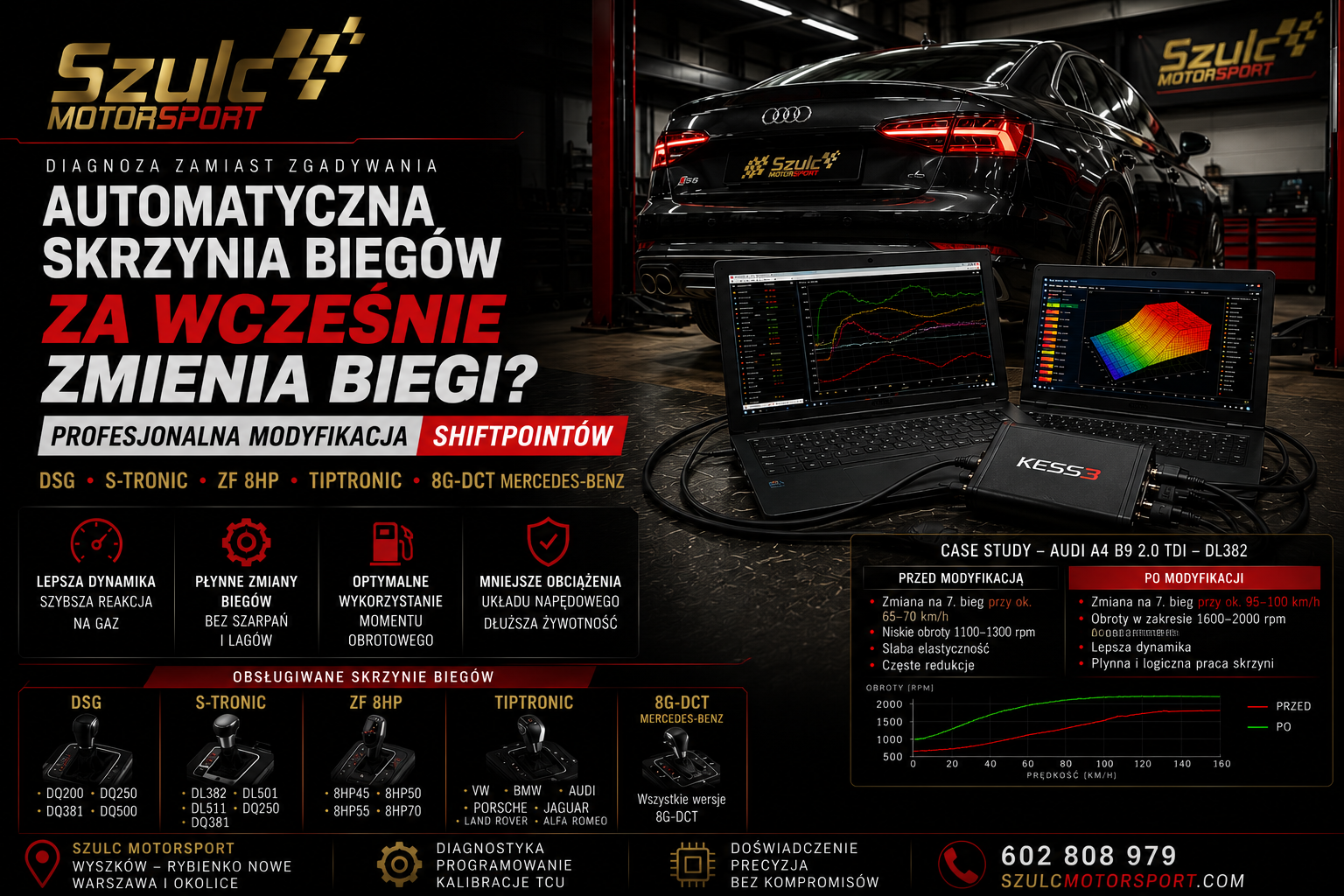
30June2026Automatic Transmission Shifts Too Early? Shift Points
Applicable to transmissions including:
DSG • S tronic • ZF 8HP • Tiptronic • selected Mercedes-Benz 8G-DCT versions
Does the automatic transmission hold the engine at 1,100–1,300 rpm, engage higher gears too early, delay downshifting and respond only after the accelerator is pressed more firmly? In many modern vehicles, this does not necessarily indicate transmission damage. It is often the result of a factory software strategy designed primarily around emissions, fuel consumption and homologation requirements.
In everyday driving, the driver experiences low engine speed, delayed throttle response, vibrations and sluggish operation in D mode. At the same time, S mode can be too aggressive and hold the engine at a considerably higher speed than necessary during normal driving.
The solution is not to drive permanently in Sport mode or move every gear-change point upwards by the same amount. Individual Shift Points optimisation changes the transmission control unit strategy so that the gearbox works more effectively with the engine characteristics, vehicle use and the driver’s expectations.
We regularly inspect vehicles that are mechanically sound and have no transmission fault codes, but still keep the engine within approximately 1,100–1,300 rpm during normal driving. If the diagnostic checks do not reveal a fault, this behaviour may result from the factory TCU logic.
Why does an automatic transmission shift too early?
Modern automatic transmission strategies are a compromise between comfort, emissions, fuel consumption and durability. During homologation testing, engaging higher gears as early as possible and maintaining a low engine speed can produce favourable results.
During gentle driving, the transmission may therefore:
- shift through the gears very quickly,
- engage sixth or seventh gear at a relatively low road speed,
- hold the engine at approximately 1,100–1,300 rpm,
- delay downshifting when the load increases gradually,
- downshift only after the accelerator is pressed more firmly,
- make the vehicle feel sluggish in D mode.
This strategy is not always a problem when driving at a steady speed. The situation changes when the vehicle accelerates, climbs a hill, carries a heavier load or requires high torque without first selecting a lower gear.
Shifting too early and shifting too slowly are different symptoms
These two symptoms should not be confused.
Shifting too early means that the transmission completes the gear change correctly but selects a higher gear at an engine speed that is too low for the current load. The shift itself may be quick and smooth, while the selected ratio is too high.
A slow or delayed gear change means that the actual shift takes too long or is accompanied by engine-speed flare, clutch slip, an impact or an interruption in torque delivery. This requires transmission diagnosis and should not be corrected simply by changing the shift points.
Delayed downshifting is another separate symptom. If the transmission remains in a high gear despite increasing load and downshifts only after the accelerator is pressed deeply, the TCU strategy may be responsible. However, incorrect engine operation, transmission faults and the input signals used by the control unit must first be excluded.
What happens at 1,100–1,300 rpm?
Operating at low engine speed does not automatically damage a vehicle. The concern is repeated high-load operation at an engine speed that is too low for the conditions.
Under these conditions:
- loads on the crankshaft, bearings, pistons and connecting rods can increase,
- the torsional vibration damping system has to absorb stronger vibrations,
- the dual-mass flywheel operates under less favourable conditions,
- engine and transmission mounts may transfer more vibration to the body,
- the engine can respond to the accelerator with a noticeable delay,
- acceleration without an appropriate downshift becomes less smooth.
In turbocharged direct-injection petrol engines, high load at very low engine speed may also promote unfavourable combustion events, including LSPI. This does not mean that using a high gear always causes pre-ignition. Load, temperature, fuel, oil, engine design and control strategy all have an influence.
Correcting the shift points does not repair worn mechanical components. It can, however, reduce situations in which the drivetrain is heavily loaded at an excessively low engine speed.
Shift Points optimisation is more than raising engine speed
The simplest approach would be to move every upshift point higher. That is not how a properly prepared modification should work.
Depending on the transmission, control unit and available software functions, we analyse parameters including:
- shift points in D mode,
- downshift logic under partial load,
- transmission response to accelerator position,
- behaviour during urban driving,
- operation in slow-moving traffic,
- the characteristics of S mode,
- the use of available engine torque,
- cooperation between the ECU and TCU software.
The aim is not to maintain unnecessarily high engine speed. The transmission should downshift earlier when the engine requires a more suitable ratio while remaining smooth and comfortable during gentle driving.
How does the vehicle change after the modification?
A correctly prepared calibration can noticeably improve vehicle behaviour without mechanically modifying the transmission.
The driver will most commonly notice:
- earlier and more natural downshifts,
- less delay after pressing the accelerator,
- less high-load driving at 1,100–1,300 rpm,
- fewer vibrations transferred to the vehicle body,
- better engine response and flexibility,
- more predictable operation in D mode,
- a smoother and more useful S mode,
- better use of the available engine torque.
The final result should feel natural. The transmission should not feel unnecessarily aggressive, and the engine should not be held at an excessively high speed during normal driving.
First, we determine whether it is a software strategy or a fault
Similar symptoms can have very different causes. Delayed downshifting may result from the factory software strategy, but jerking, delayed drive engagement, clutch slip or vibration may also be associated with the clutch packs, dual-mass flywheel, mechatronics, control unit, transmission fluid or incorrect engine operation.
The diagnostic procedure is selected for the specific vehicle and reported symptoms. Depending on the case, we check:
- fault codes stored in the engine and transmission control units,
- TCU identification and software version,
- clutch adaptation values,
- transmission operating temperature,
- mechatronic control parameters,
- clutch engagement times,
- transmission behaviour during a road test,
- engine operation under load,
- the condition and service history of the transmission fluid.
We do not modify the software to conceal a mechanical fault. If the transmission requires servicing or repair, we first identify and eliminate the actual cause of the problem.
Not every transmission requires the same testing procedure. A DSG DQ200 is diagnosed differently from an S tronic DL382 or a conventional ZF 8HP automatic transmission. The procedure must match the design of the specific gearbox.
The DL382 is a good example because similar symptoms may result from the TCU strategy or from the condition of the transmission fluid, filters, seals, clutch packs, mechatronics or mechanical section. More information is available here: DL382 and DL382+ S tronic – diagnostics, servicing, TCU programming and repair.
Workshop example: not every transmission jerk requires software modification
In an Audi A6 C8, jerking after gear changes and drivetrain binding while turning were not caused by the TCU strategy. Inspection revealed several irregularities affecting the DL382 transmission and other sections of the drivetrain.
In this situation, changing the shift points would not have been the correct first step. The vehicle first required complete diagnosis, correct servicing of the transmission, repair of the quattro Ultra system and rear final drive, followed by the required adaptation procedures.
The complete repair process is described here: Audi A6 C8 DL382 – incomplete transmission and quattro Ultra service.
How do we perform a Shift Points modification?
- We discuss the vehicle’s behaviour and the expected result with the driver.
- We identify the transmission type, TCU and software version.
- We check fault codes, operating parameters and adaptation values.
- We perform a road test and assess the actual upshift and downshift points.
- If the transmission is operating correctly, we prepare an individual software modification.
- We program the control unit and perform the procedures required for that transmission.
- We complete a final road test and verify the operating parameters.
Not every transmission and software version offers the same modification possibilities. The available scope is determined after identifying the control unit and checking the specific vehicle.
Does Shift Points optimisation increase engine power?
Changing the shift points does not itself increase engine power. It changes how the available torque is used by selecting a more appropriate ratio and downshifting earlier when the load increases.
Shift Points optimisation can be performed on a standard vehicle or one with previously modified engine software. In every case, the TCU strategy must correspond to the vehicle’s actual operating parameters.
Is transmission adaptation alone sufficient?
Adaptation does not modify the factory shift-point maps. It may be required after certain repairs or service procedures, but it will not correct behaviour caused by the standard TCU strategy.
If the cause is a mechanical, hydraulic or electrical fault, software modification will not eliminate it either. The first step is therefore to distinguish the control strategy from an actual transmission fault.
Individual Shift Points optimisation – Warsaw / Wyszków
At Szulc Motorsport, we provide diagnostics and individual shift-point modifications for DSG, S tronic, ZF 8HP, Tiptronic and selected Mercedes-Benz 8G-DCT transmissions.
Every vehicle is checked before the software is modified. We analyse the transmission design, control unit version, operating parameters and vehicle behaviour during a road test. The software is prepared for the specific vehicle, and the final result is verified during post-programming testing.
Szulc Motorsport – automatic transmission diagnostics and individual TCU software modification. Warsaw / Wyszków.
Diagnosis instead of guesswork.