


15August2026Audi TFSI at 107°C – Thermal Management and Safe Temperature Reduction
In older cars, drivers became used to one simple rule: coolant temperature should remain close to 90°C. When diagnostic data shows 105, 107 or even 110°C, the immediate concern is usually that the engine is running too hot.
In modern Audi and Volkswagen Group engines, however, temperature cannot be judged from one number alone. The engine control unit no longer tries to maintain one fixed coolant temperature. It adjusts the thermal strategy according to engine load, vehicle speed, driving conditions, oil temperature, cabin-heating demand and emissions requirements.
The correct question is therefore not simply:
“Is 107°C too high?”
A more useful question is:
“Why is the control unit targeting this temperature under these particular operating conditions?”
Does 90°C on the Dashboard Mean the Coolant Is Actually at 90°C?
In many vehicles, the coolant-temperature gauge is deliberately stabilised across a wider operating range. It does not display every small change measured by the engine control unit. This prevents the needle from moving continuously during normal operation and unnecessarily worrying the driver.
As a result, the dashboard may still show 90°C while live diagnostic data reports 98, 103 or 107°C. That alone does not indicate a fault. The dashboard gauge is a simplified driver display; proper diagnosis is based on actual measured values.
Even a live-data value should not be interpreted in isolation. Coolant temperature must be assessed together with engine load, oil temperature, the commanded position of thermal-management components, fan operation and the conditions in which the vehicle is being driven.
Why Was a Conventional Thermostat Once Enough?
In a traditional cooling system, the thermostat was primarily a mechanical component. Once a defined temperature was reached, it gradually opened the flow through the radiator. The system was comparatively simple, and the engine generally operated within a relatively narrow temperature range.
As engines evolved, the requirements became more demanding. The engine had to warm up more quickly, use less fuel, produce fewer emissions, deliver high power and remain stable in city traffic, on the motorway, in winter, in summer and under heavy load.
One fixed temperature was no longer the best compromise for every situation. That is why the conventional thermostat was supplemented or replaced by a more complex system controlling coolant flow and heat distribution.
From the 1.8T and EA113 to the EA888 Family
Older 1.8T engines and many EA113 units used a more conventional cooling philosophy. The system’s main task was to keep the engine within a safe temperature range and remove excess heat. The engine control unit had relatively limited influence over how quickly coolant circulated and which areas were heated or cooled first.
In the EA888 family, thermal management became part of the engine’s overall operating strategy. Coolant flow can be controlled to warm selected areas more quickly, reduce heat losses during warm-up, maintain a higher temperature under light load and increase cooling capacity as thermal load rises.
It is therefore more accurate to describe the system as thermal management rather than simply engine cooling.
What Does Thermal Management Actually Mean?
Thermal Management is the controlled distribution of heat throughout the powertrain. Its purpose is not to keep the engine as cool as possible at all times. An engine that remains too cold also suffers disadvantages: higher internal friction, a longer enrichment phase, poorer evaporation of fuel and moisture from the oil, and slower activation of exhaust aftertreatment systems.
The control unit therefore searches for a compromise. Under light load, it may allow a higher coolant temperature because this can reduce some mechanical losses and support efficiency. When the driver demands more torque, the strategy can lower the target temperature to increase knock resistance, reduce local thermal stress and protect components exposed to high heat loads.
This leads to an important engineering conclusion:
If 107°C were always the ideal temperature, the control unit would not deliberately reduce it under high load.
The fact that it does so proves that the optimum temperature depends on operating conditions.
Factory-approved does not always mean optimal for many years of ownership. A coolant target of 105–107°C can be part of the original strategy, but it still represents a high thermal regime. In a vehicle kept for the long term, frequently driven in traffic, used on short journeys or running increased power, earlier activation of effective cooling can reduce thermal stress on the oil, seals, plastic components and parts operating in the hottest areas of the engine.
Does 107°C Represent the Temperature of the Entire Engine?
No. A coolant-temperature sensor measures temperature at one specific point in the system. It does not directly show piston-crown temperature, ring-belt temperature, bearing temperature, turbocharger oil temperature, exhaust-valve area temperature or exhaust-gas temperature upstream of the turbine.
An engine does not have one single temperature. At the same moment, different components operate under completely different thermal conditions. Coolant removes heat from some areas, oil carries heat away from others, and a large proportion of the energy leaves the engine through the exhaust system.
A reading of 107°C should therefore be treated as one part of the overall heat balance, not as a complete assessment of engine condition.
Where Does the Energy from the Fuel Go?
An internal-combustion engine does not convert all of the fuel’s energy into vehicle propulsion. Only part of that energy becomes useful mechanical work. The rest must leave the engine through the exhaust gases, coolant, oil and heat radiated from the engine and its surroundings.
The greater the load, the more energy passes through the engine per unit of time. Exhaust-gas temperature rises, while the turbocharger, pistons, valves, cylinder head and oil all experience greater thermal stress. That is why the same coolant temperature cannot be interpreted in the same way during relaxed cruising and after sustained high-speed or high-load driving.
The meaning of a temperature value depends partly on what the vehicle was doing in the minutes before the reading was taken.
Why Can a Higher Temperature Improve Efficiency?
Once the engine is fully warmed, internal friction decreases and the oil reaches the viscosity range intended for normal operation. A higher operating temperature can also reduce certain heat losses and help the manufacturer meet fuel-consumption and emissions targets.
This does not mean that hotter is always better. As temperature rises, oil viscosity falls, material temperatures increase and the safety margin against knock becomes smaller. From an engineering perspective, the target must therefore be high enough for efficiency but low enough to protect the engine under load.
What Happens to the Oil as Temperature Rises?
The oil becomes thinner. This is normal and is taken into account during engine design. The risk increases when high temperature is combined with oil that is too thin for the actual conditions, fuel dilution, excessive oil age, an unsuitable service interval or incorrect lubrication-system pressure.
The oil film separating loaded surfaces depends on far more than the viscosity grade printed on the container. Engine speed, load, temperature, bearing clearances, pump condition, contamination and the oil’s actual remaining performance all matter.
This is why two owners of the same engine can see very different mechanical condition at a similar mileage. One vehicle may spend most of its life on long journeys with oil changes every 10,000 km. Another may operate mainly on short urban trips, undergo frequent cold starts and follow the maximum service interval. The nominal coolant temperature may be similar, but the conditions in which the oil works are not.
Is Engine Oil Part of the Cooling System?
Yes. Oil does more than lubricate. It also absorbs heat from bearings, pistons, camshafts, the turbocharger and other highly loaded components. It then releases that heat through the sump or through an oil-to-coolant heat exchanger.
This is why coolant temperature should not be evaluated without considering oil temperature. The coolant may be within a normal range while the oil remains extremely hot after intensive driving. The opposite can also occur: the coolant reaches its operating temperature quickly while the much larger oil mass is still not fully warmed.
Why Do Modern Engines Use Variable-Output Oil Pumps?
Maintaining maximum oil pressure under every operating condition would consume additional power. Modern engines therefore often use regulated lubrication systems that adapt oil pressure and pump output to the engine’s current requirements.
Under light load, the control unit may reduce pressure to lower the energy consumed by the pump. At higher load, pressure should be increased. The principle is logical, but it depends on correct operation of the pump, control valves, sensors, software and the correct oil specification.
If any part of the system does not operate properly, diagnosis cannot be limited to one pressure reading at idle. What matters is how pressure changes with oil temperature, engine speed and load.
Why Does the Control Unit Lower Temperature Under High Load?
During dynamic driving, more heat is produced inside the cylinders. Higher temperatures increase the tendency to knock and place greater thermal stress on the pistons, valves, cylinder head and turbocharger. Reducing coolant temperature increases the system’s ability to absorb heat and gives the engine a larger safety margin.
This is the clearest proof that Thermal Management is not designed to maintain the highest possible temperature. It is designed to maintain the temperature best suited to the current task.
During gentle driving, efficiency may be the priority. Under full load, mechanical protection and knock resistance become more important.
What Role Does Knock Play?
Knock is an uncontrolled and extremely rapid combustion event that produces high local pressures and temperatures. The control unit counteracts it by adjusting ignition timing, boost pressure, fuelling and the engine’s thermal strategy.
The hotter the intake charge, combustion chamber and surrounding engine components become, the smaller the available knock margin may be. Cooling under load is therefore not merely about keeping the engine comfortable; it is part of controlling the combustion process itself.
Does the Turbocharger Operate Under the Same Conditions as the Rest of the Engine?
No. The turbocharger is one of the most thermally stressed components in the engine. Extremely hot exhaust gases flow through the turbine housing, while the shaft rotates at very high speed. At the same time, its bearing system relies on a stable supply of clean oil.
After intensive driving, heat stored in the turbine housing does not disappear immediately when the driver lifts off the accelerator. It continues to transfer into the oil and surrounding components. Oil quality, post-load driving behaviour, coolant circulation and the operation of auxiliary electric coolant pumps, where fitted, are therefore all relevant.
What Is Heat Soak?
Heat soak is the rise in temperature of certain components after engine load has already been reduced or the vehicle has stopped. While driving, airflow and active coolant circulation remove heat. Once the vehicle stops, airflow drops sharply, but the heat stored in the turbocharger, exhaust manifold, cylinder head and exhaust system continues moving into cooler surrounding areas.
This is why a vehicle may still require active cooling after hard driving even though the engine is no longer under load. Fans running after the vehicle has stopped, or an auxiliary coolant pump continuing to circulate coolant, do not automatically indicate a fault. They may be a correct response to the stored thermal energy.
Does Every Driver Place the Same Thermal Load on the Engine?
There is no single “average” operating pattern. The same engine may spend most of its life on motorways, in urban traffic, on short journeys, towing a heavy trailer or being used only occasionally. The number of cold starts, oil warm-up time, particulate-filter regeneration frequency, fuel dilution and thermal load can all differ significantly.
The manufacturer must design one engine and one core strategy for millions of users. The result is necessarily a compromise between emissions, cost, comfort, fuel consumption, performance and expected durability.
A workshop, however, sees one particular vehicle, its service history and its real operating conditions. Service recommendations should therefore take into account not only model and mileage, but also how the vehicle is actually used.
Why Do Two Identical Engines Age Differently?
Durability is affected by the sum of many small decisions: oil-change frequency, filter quality, warming the engine before high load, allowing temperatures to stabilise after hard use, crankcase-ventilation condition, injector performance, mixture control, cooling-system condition and control-unit software.
One parameter rarely damages an engine by itself. Problems usually develop when several unfavourable factors overlap. For example, an extended oil interval, frequent short journeys, fuel dilution and high oil temperature can together accelerate oil degradation far more than any one of those factors alone.
When Can 107°C Indicate a Problem?
The concern should not be the number by itself, but a lack of logical system response or the presence of additional symptoms. Examples include:
- temperature continuing to rise during gentle driving with good airflow,
- the control unit requesting strong cooling while the temperature does not fall,
- cooling fans not responding to the commanded value,
- large discrepancies between temperature sensors,
- unstable cabin heating,
- coolant loss, excessive system pressure or repeated air pockets,
- oil temperature remaining disproportionately high,
- the vehicle entering a protection mode or storing thermal-management faults.
In these situations, the entire system must be diagnosed. Replacing the thermostat or water pump purely because of one temperature value is not a reliable method.
How Should the Thermal-Management System Be Diagnosed?
The first step is to establish the conditions in which the symptom occurs. A vehicle that overheats in traffic must be approached differently from one that develops a problem only at motorway speed, and differently again from an engine that warms too slowly.
The next step is to compare actual values with the control unit’s requested values. Relevant information includes:
- temperatures reported by the available sensors,
- engine-oil temperature,
- commanded and actual operation of regulating components,
- cooling-fan request and actual response,
- engine load and vehicle speed,
- cooling-system pressure,
- flow through the heater core and radiator,
- condition of the coolant pump, valves and thermal-management module,
- stored faults and the conditions in which they were recorded.
In many cases, a road test with parameter recording is required. A graph shows whether the system responds correctly when load changes. A reading taken while the vehicle is stationary may not reveal a fault that appears only during driving.
Why Does Replacing the Water Pump Not Always Solve the Problem?
In EA888 engines, the coolant pump, thermostat housing and regulating elements form a complex assembly. The fault may involve leakage, pump drive, a control element, a sensor, wiring, air trapped in the system or incorrect interpretation of the measured data.
If the failed function is not identified before parts are replaced, a new component may not remove the root cause. It is also easy to overlook a problem involving coolant flow, the radiator, fans or control strategy.
The same rule therefore applies: first understand the relationships and confirm them with measurements; only then decide what should be repaired.
Why Is Coolant Condition So Important in Modern TFSI Gen.4 and Gen.5 Engines?
In the latest generations of TFSI engines, the coolant passages in the cylinder block and cylinder head are designed with relatively small cross-sections, while the amount of coolant surrounding the combustion chambers and flowing through the narrow areas between the cylinders is limited. If the system contains old, degraded or incorrectly diluted coolant, its thermal stability and resistance to boiling can deteriorate. At a coolant temperature of approximately 105–107°C and under high local thermal load, the temperature of the metal surface in the most heavily stressed areas can be significantly higher than the temperature measured by the coolant sensor. Under these conditions, particularly with degraded coolant, incorrect concentration or restricted coolant flow, local nucleate boiling can occur on the hottest metal surfaces. The microscopic vapour bubbles that form reduce direct contact between the coolant and the metal surface and impair heat transfer. As a result, the temperature sensor in the main circuit may still show values that do not appear critical, while the local material temperature in the most heavily loaded areas of the cylinder head or between the cylinders is already significantly higher.
Checking Coolant Concentration, Boiling Resistance and Protective Properties
Assessing coolant condition solely with a refractometer and checking its freezing point is not sufficient. Glycol may continue to provide frost protection for a long time, while corrosion inhibitors, anti-cavitation additives and the components responsible for protecting the coolant pump, seals and metal surfaces gradually deteriorate. Correct concentration is also important: excessive dilution lowers the boiling point and reduces corrosion protection, while too much concentrate can impair the mixture’s ability to absorb and transfer heat. At Szulc Motorsport, when servicing modern VAG engines, we check not only the coolant level and freezing point, but also its concentration, condition and resistance to boiling. In engines designed to operate under a high thermal regime, old, unsuitable or degraded coolant can directly reduce thermal stability and accelerate wear of cooling-system components.
Can the Operating Temperature Be Lowered through Software?
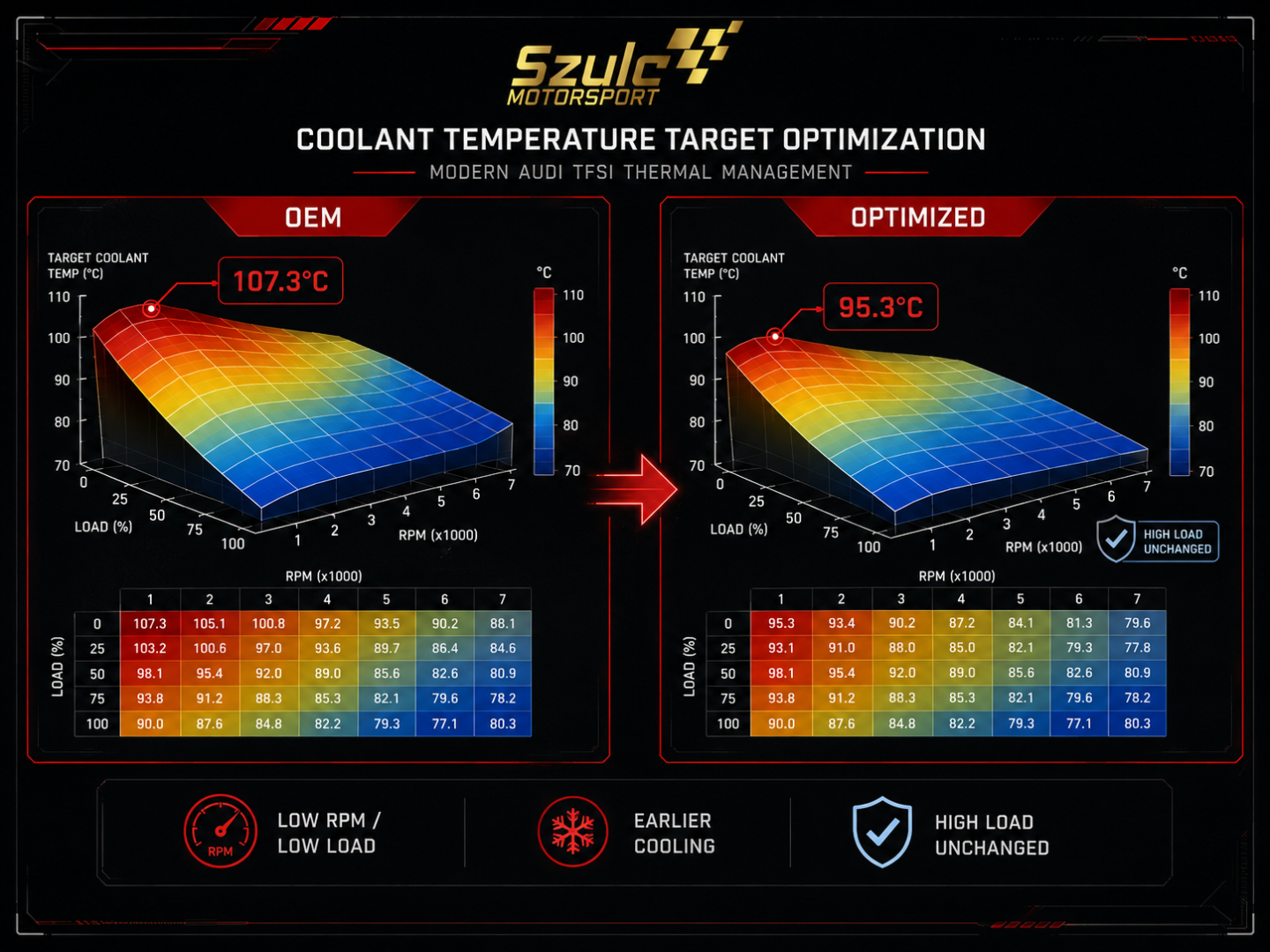
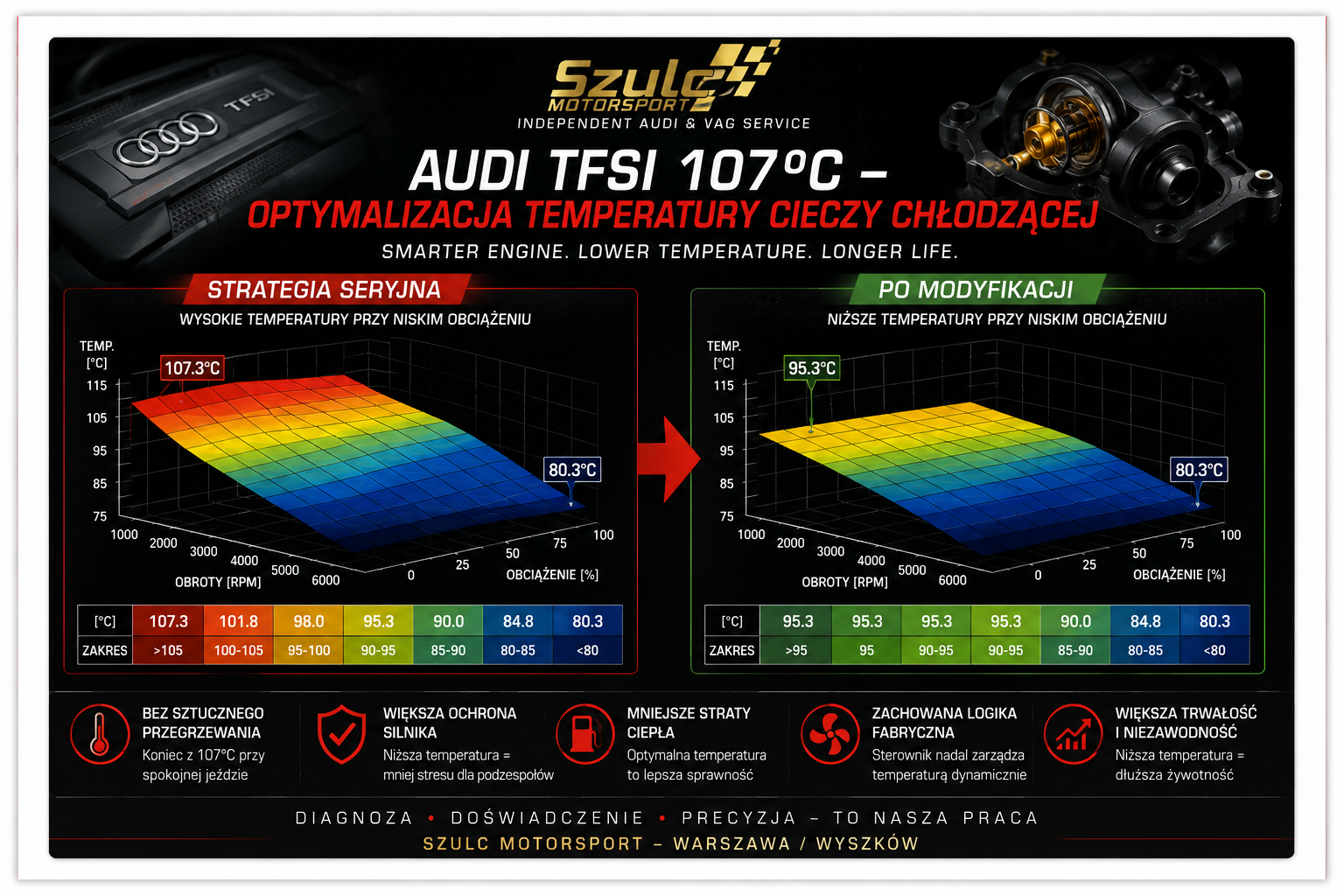
Yes. In selected Audi TFSI control units, the Thermal Management strategy can be recalibrated so that the cooling system begins working more intensively earlier during normal driving and partial-load operation. This is not the same as forcing one fixed temperature across the entire engine operating range.
A correctly developed calibration primarily reduces the high requested-temperature values used at low and medium load. The lower factory targets intended for high-load operation remain unchanged because the control unit already increases cooling intensity in those conditions.
Coolant-flow control is adjusted accordingly so that the system can achieve the requested effect earlier. The control unit continues to manage temperature dynamically according to engine speed, load and the current thermal state. The factory Thermal Management logic is retained; only its behaviour during everyday operation is refined.
The mechanical condition of the cooling system and recorded operating parameters must always be checked first. Software calibration cannot repair a defective coolant pump, thermal-management module, sensor, fan or degraded coolant.
The diagram illustrates the principle: lower requested temperature earlier at low and medium load while retaining the lower factory targets used under high load.
Does the Maximum Oil-Service Interval Suit Every Vehicle?
A service interval is an approved limit based on defined operating assumptions. It is not necessarily the optimum interval for every driver. Short journeys, repeated cold starts, city traffic, high engine output, software modifications and long periods of idling all accelerate oil ageing.
In workshop practice, a safer reference point for many direct-injection engines is an oil change no later than every 10,000 km or once a year, with a shorter interval where operating conditions are severe.
This does not mean that every engine will fail if the oil is used for longer. It is a practical conclusion based on the fact that the oil must lubricate, cool, clean and neutralise combustion by-products at the same time.
Can the Choice of Oil Solve Everything?
There is no single oil that is best for every engine and every driving pattern. The manufacturer approval, viscosity, engine design, particulate-filter requirements, operating temperature, engine load and replacement interval all matter.
The engine’s condition is just as important as the product selected. Even a very high-quality oil cannot repair a worn pump, leaking injector, faulty crankcase ventilation system, an overheating engine or severe fuel dilution.
Oil selection should be the final part of a logical assessment, not an attempt to hide an unresolved mechanical problem.
What Does Workshop Experience Show?
In real workshop conditions, some high-mileage engines remain mechanically healthy, while other units with much lower mileage already show serious problems. Mileage alone does not explain the difference.
The deciding factors are often the vehicle’s history: service frequency, repair quality, warm-up habits, the number of short journeys, fuel quality, cooling-system condition and how quickly early symptoms were investigated.
That is why even a routine oil service should involve more than replacing the filter and drain plug. Checking for leaks, coolant condition, thermal-system operation, mixture behaviour, crankcase ventilation and stored faults can reveal a developing problem before it becomes an expensive failure.
Does the Manufacturer Design the Engine for One Driver?
No. The engine is designed for millions of users, different markets, fuels, climates and regulations. Performance, emissions, fuel consumption, production cost, comfort and durability all have to be balanced.
The factory strategy is therefore always a compromise. It is not automatically wrong simply because it is not ideal for one particular driver. At the same time, this does not mean that every factory calibration is optimal for a vehicle used in unusual or consistently demanding conditions.
The role of a competent workshop is to understand how a particular vehicle is used and whether its operating values still follow the logical relationships intended by the design.
So, Is 107°C a Problem?
After looking at the complete system, the answer is no longer simply yes or no.
A value of 107°C does not, by itself, prove either correct operation or overheating. It is one of the parameters used by the control unit to implement the engine’s thermal strategy.
What matters far more is why the control unit is targeting that temperature in those conditions and whether the system responds correctly when load changes.
From a diagnostic perspective, the most important question is not:
“What is the coolant temperature?”
The more useful question is:
“Why is it at this temperature, and do the remaining parameters confirm that the system is operating correctly?”
Key Conclusions
- 107°C does not automatically mean that the engine is overheating.
- A dashboard reading of 90°C may represent a wider actual coolant-temperature range.
- A modern engine does not operate at one fixed temperature.
- The control unit may allow a higher temperature under light load and reduce it during more demanding driving.
- Coolant temperature is only one element of the engine’s total heat balance.
- Engine oil lubricates, cools and carries contamination at the same time.
- In TFSI Gen.4 and Gen.5 engines, correct coolant concentration, boiling resistance and the condition of its protective additives are particularly important for stable heat transfer.
- Durability depends on operating conditions, service intervals, cooling-system condition and repair quality.
- Correct diagnosis requires analysis of relationships and recorded parameters, not judgment based on one number.
- In selected Audi TFSI engines, the Thermal Management strategy can be calibrated to reduce the requested temperature earlier in the lower engine-speed range.
Szulc Motorsport conclusion: a coolant temperature of 105–107°C can be a normal part of the factory Audi TFSI operating strategy, but it is not the only possible strategy. After confirming that the cooling system is mechanically sound, selected control units can be recalibrated to request a lower temperature earlier in the lower engine-speed range. A properly developed modification retains active thermal control, begins stronger cooling earlier and increases the engine’s thermal margin during everyday driving.
Szulc Motorsport – independent Audi and VAG diagnostics, Warsaw / Wyszkow.
If your Audi TFSI continuously operates at 105–107°C during normal driving, the first step is to confirm that the cooling system is mechanically sound. Once this has been verified, an earlier-cooling calibration can be developed for the specific ECU, engine and vehicle usage. Szulc Motorsport – independent Audi and VAG diagnostics and calibration, Warsaw / Wyszkow.